Pre-test: The Blamed Bladder
| Questions | 3 |
|---|---|
| Attempts allowed | Unlimited |
| Available | Always |
| Pass rate | 75 % |
| Backwards navigation | Allowed |
You are not allowed to take this Quiz.

| Questions | 3 |
|---|---|
| Attempts allowed | Unlimited |
| Available | Always |
| Pass rate | 75 % |
| Backwards navigation | Allowed |
D’Arcy Little, MD, CCFP, FRCPC
Medical Director, JCCC and HealthPlexus.NET

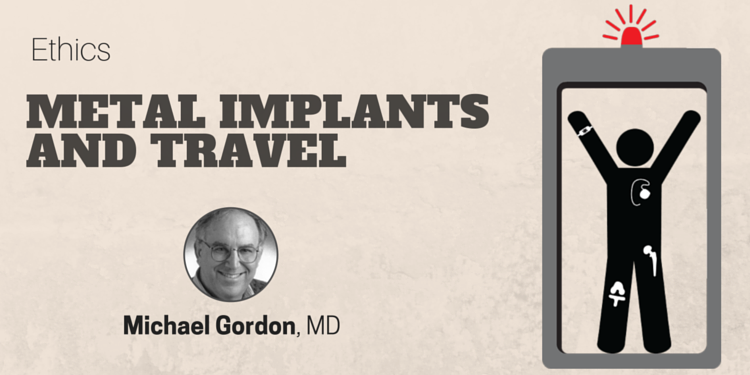
Many older patients of mine have metal implants in their limbs following some form of reconstructive surgery. It is the age of the bionic person.
With so many "snowbirds" and with security metal detectors almost everywhere, there is often an expressed concern about whether having a metal implant in the hip or knee might delay you or lead to problems when you pass through airport or cruise security metal detectors.
I recently had a comparable experience when flying, which I do quite often. I had acquired a MedicAlert bracelet, which also is a common accoutrement of many older patients. As I passed through the security arch having already removed all my usual triggers (phone, wallet, belt, watch), the alarm went off—I realized that the Medic-Alert bracelet, whose clasp is such that it is very difficult to open, clearly for safety reasons, was the culprit. I mentioned it to the agent—who took his wand and clearly identified the source of the alarm, and when he finished the rest of the scan, he let me through without any problems.
I was curious and perused the medical literature on the subject, given the high prevalence of seniors with metal in their bodies—part of the contemporary miracle of modern medicine. I recall a time when severe knee and hip arthritis left seniors either completely immobilized or chronically racked by significant, often life-altering pain.
It is not that the surgery is "easy," and it's not always successful, but for many, it can have a dramatic and long-lasting beneficial effect. No less important than the surgery itself is that there seems to be a very flexible ceiling on age—with some very elderly individuals found suitable for surgery—depending on what other medical conditions exist.
Many of the articles that discuss the issue remark on a practice in the past, when patients with metal hardware in their bodies often provided the security agents with letters or cards attesting to their condition. However, it is now felt that these are not needed nor heeded, as there is no way of verifying the veracity of the author—and the backup metal detector or full body scan will do the trick more effectively and assuredly.
What most of the articles on the subject suggest is that the traveller should alert the security agent right up front about the issue rather than waiting for the detector to go off. I thought of having the clasp on my MedicAlert bracelet changed to one that could be more readily opened and closed but decided that the security of a bracelet that could not readily inadvertently fall off was more important than the minor inconvenience of a manual security scan.
Some things, we often say, just "come with the territory." Travel has become more complicated because of issues of security. There is no doubt that the recent tragic bombing of a passenger plane in the Middle East will result in either more intense scrutiny of travellers or some new directives on screening—just when things seemed to be easing up in North American airports.
Medicine has become more complicated because of novel treatments that, although life enhancing or life saving (such an internal heart pacemaker which also has metal wires), may cause some modicum of inconvenience at the security gate when people travel.
This seems to be a small price to pay to achieve both desirable ends—being able to walk unattended through a security gate after restorative surgery, and making sure that fellow travellers are safe in their travels.
Still, during those years when I was studying medicine all this would have been in the realm of wild imagination.
This article was originally published online at http://www.cjnews.com/living-jewish/travel/do-metal-implants-hinder-your-ability-to-travel
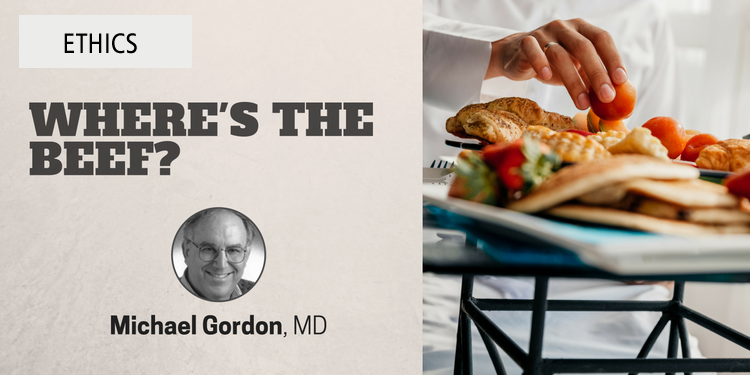
I was sitting in a coffee shop next to table with 5 older women. I could hear one of them say to the group, "I am cutting bacon out of my diet—but I do love it once in a while". "Why are you doing that, one of the woman replied?" "I just read that bacon and salami and hamburgers can cause cancer—didn't you see the paper yesterday—it was also on the news last night—it is almost as bad as smoking cigarettes—who would know—I hope it isn't too late as I have bacon at least once a week on the weekends when we go out for breakfast."
It always amazes me how when something is reported in the media, the response ranges from hyperbolic concern by reporters and the public to complete lack of concern by others. It can be very hard for the public, and at times the medical profession to decipher the real implications of the many reports that focus on public health threats from the world around us. I have watched as items such as eggs, coffee, various fats and oils, alcohol, different types of exercise and where we live and what we breathe become the focus of notices to the public to either "beware," "take heed," "change practice" or "just stop what you are doing".
Some public health warnings are real and immediate and often due to the finding or some food item that is being eaten or prepared in "real time" that poses an immediate threat to consumers. A recent example is the warning and resultant steps taken by the restaurant chain Chipotle where at the time of writing, "More than 40 people have fallen ill with E. coli food poisoning after eating at Chipotle Mexican Grill restaurants in six different states…the outbreak expanded with new Chipotle-linked E. coli cases reported in California, Ohio, New York and Minnesota, the U.S. Centers for Disease Control and Prevention said."
This type of warning is reminiscent of those that are propagated by public health agencies during BBQ season reminding consumers to BBQ their chicken and hamburgers particularly well because of risks of E-Coli outbreaks—a ubiquitous bacteria that can be destroyed by proper cooking but may linger in undercooked or rapidly cooked meet where the necessary bacterial-killing inside temperature is not reached. In 1993 there was a serious outbreak in the Jack in the Box chain of fast-food outlets in the United States that resulted in hundreds of illnesses some of which resulted in chronic and serious illnesses—it had a profound impact on new standards for food preparation in the fast-food industry.
These warnings are different from public health warnings about eating habits—having watched the potential harmful effects of coffee come and go over the years, I was forever grateful that the final estimation of this almost universally consumed drink, is that it probably has more beneficial effects on health parameters than negative ones—for me coffeeophile a public health blessing: yet the European Union recently recommended against drinking more than four cups of coffee a day based on caffeine consumption. In contrast is the recent report that," Hold on tight to that cup of Joe—because it could save your life. New research out of the Harvard School of Public Health says lifelong coffee lovers could be at less risk of dying from type two diabetes, suicide, cardiovascular and neurological diseases. "We found people who drank three to five cups of coffee per day had about a 15 percent lower [risk of premature] mortality compared to people who didn't drink coffee," one of the authors of the study, Walter Willett, told NPR.
So what about the bacon, hot dogs, corned beef and pastrami? What about the BBQ steaks and hamburgers? Does everyone who is not an life-long vegetarian or subscribe to the Mediterranean diet run the risk of sudden death from a BLT or hot dog at their favorite ball game? That a recent study in the US reveals that 57% of American Jews eat pork in one form or another (http://www.pewforum.org/files/2015/11/201.11.03_RLS_II_full_report.pdf)—should not necessarily be interpreted as a sure sign of anti-religious drift or impending doom, but rather the way surrounding cultures and practices influence people of all ethnic and religious backgrounds.
The final message should be: Most things can be eaten in a moderate and balanced fashion, unless there are specific health-related concerns for an individual—more important than how much bacon, meat and pastrami one eats, is that the portions are in keeping with one's individual nutritional needs, that they are balanced with other non-meat foods, including vegetables and fruits and that they are prepared and cooked well Food is one of the most enjoyable aspects of life—we should not make ourselves obsessively concerned every time a new "warning" comes out about the dangers of life and what we eat—hang in there—likely the recommendation will change over time—take it all in stride- with a dollop of mustard.
This article was originally published online at http://www.cjnews.com/perspectives/ideas/wheres-the-beef
D’Arcy Little, MD, CCFP, FRCPC
Medical Director, JCCC and HealthPlexus.NET
| Questions | 5 |
|---|---|
| Attempts allowed | Unlimited |
| Available | Always |
| Pass rate | 75 % |
| Backwards navigation | Allowed |