Advertisement

Advertisement

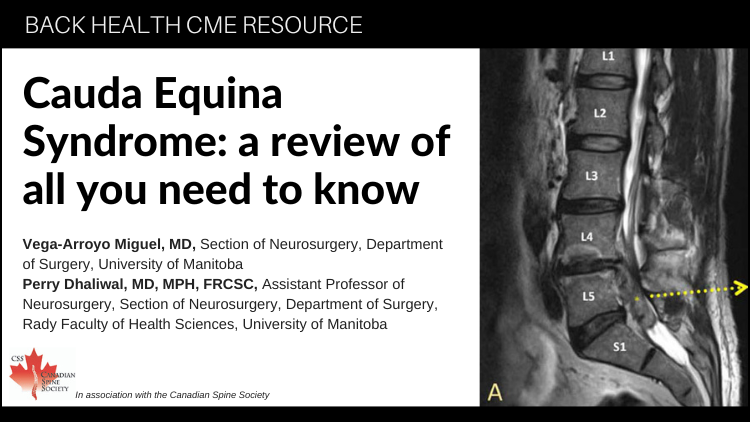
Cauda Equina Syndrome: a review of all you need to know

Teaser: 

Vega-Arroyo Miguel, MD,1 Perry Dhaliwal, MD, MPH, FRCSC,2

1 Section of Neurosurgery, Department of Surgery, University of Manitoba.
2 Assistant Professor of Neurosurgery, Section of Neurosurgery, Department of Surgery, Rady Faculty of Health Sciences, University of Manitoba.

CLINICAL TOOLS

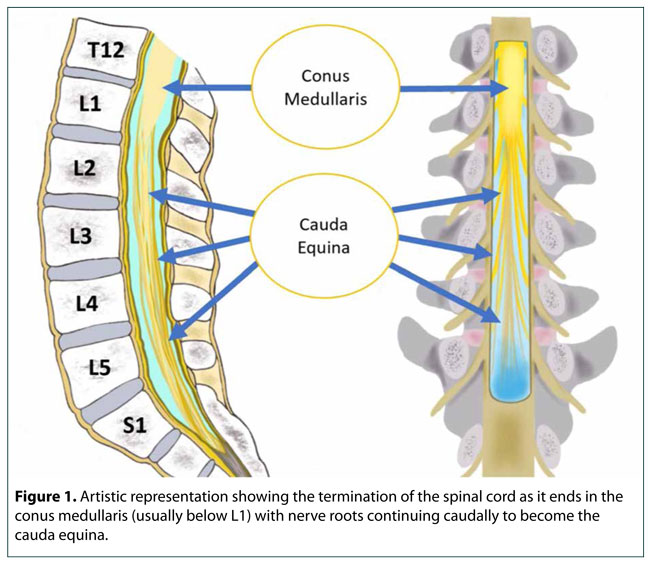
Abstract: Cauda equina syndrome (CES) is the collection of signs and symptoms produced by severe compression of the lumbar spinal nerves that form the cauda equina. The compression can be caused by lumbar degenerative changes, intraspinal tumors, epidural hematoma, and infections. Rapid diagnosis and treatment are paramount as CES requires emergent surgical decompression. With delay, the patient could develop permanent neurological deficits including loss of lower limb sensorimotor function, bladder, bowel, and/or sexual dysfunction. Unfortunately, even with expeditious surgery, neurological improvements remain unpredictable. Failure to fully explain the possible prognoses can involve all the healthcare providers in medicolegal consequences.
Key Words:Cauda Equina Syndrome, Spine Emergency, Urinary retention, MRI scanning, Saddle Anesthesia.

Members of the College of Family Physicians of Canada may claim MAINPRO-M2 Credits for this unaccredited educational program.

www.cfpc.ca/Mainpro_M2

You can take quizzes without subscribing; however, your results will not be stored. Subscribers will have access to their quiz results for future reference.

1. Cauda Equina Syndrome results from pathologies that compress the nerves in the lumbosacral spinal canal, most commonly due to an acute lumbar disc herniation.
2. Early diagnosis is crucial and is made clinically by distinctive symptoms of saddle anesthesia, acute urinary incontinence combined with acute back and leg pain.
3. The most consistent early clinical sign of CES is urinary retention, and the prognosis is worse when present.
4. Urgent MRI is the study of choice and should be performed to confirm or rule out CES.
5. Surgery is highly recommended within 24 hours after CES is identified.
1. Cauda Equina Syndrome is caused by a large space-occupying lesion within the central canal of the lumbosacral spine, most commonly a large disc herniation. However, compression can also be caused by lumbar degenerative changes, intraspinal tumors, epidural hematoma, and infections.
2. Cauda equina syndrome generally presents with varying degrees of sensory loss and motor weakness in the lower extremities, saddle anesthesia, and bowel/bladder dysfunction (these last 2 are required to establish the diagnosis of CES).
3. The main clinical feature between differentiating Cauda Equina Syndrome vs Conus Medullaris Syndrome, is the absence of UPPER MOTOR NEURONS findings in CES).
4. About 70% of patients with cauda equina syndrome have a previous history of lower back pain and/or sciatica.
5. Although the prognosis is largely determined by the preoperative severity of neurological deficits, early surgery improves the chance of significant recovery so patients with CES require urgent surgical intervention.
To have access to full article that these tools were developed for, please subscribe. The cost to subscribe is $80 USD per year and you will gain full access to all the premium content on www.healthplexus.net, an educational portal, that hosts 1000s of clinical reviews, case studies, educational visual aids and more as well as within the mobile app.

Test Quiz

Questions2
Attempts allowedUnlimited
AvailableAlways
Pass rate75 %
Backwards navigationAllowed
You are not allowed to take this Quiz.

Attacked by Two Toros

Teaser: 

As a physician for almost sixty years, I often write about my medically related experiences as well as books to assist the lay audience to understand the wonderment and mysteries of medicine.

Disclaimer: 
Disclaimer at the end of each page

#29: Decoding Long Covid: Navigating Persistent Symptoms and Self-Management

Welcome to 3P: Pills, Pearls, and Patients where we will discuss current events in medicine, stories from real patient-physician encounters, and gain insight into what it's like being a physician in today's society.

Please note that while the first episode is available to listen to without registration, accessing additional episodes will require you to subscribe and log in.

  Back to Pills, Pearls & Patients (3P)

Hello and welcome to the next episode of 3P: Pills, Pearls and Patients. Today we're going to be talking about Long Covid.

...


1

5 applauses

Dr. Marina Malak is a family physician in Mississauga, Ontario and a lecturer and faculty member at the University of Toronto. She is actively involved in medical advocacy, and is a board member of the Mississauga Primary Care Network. She is also a member of the National Committee of Continuing Professional Development at the College of Family Physicians of Ontario, and a member of the Research Ethics Board at Trillium Health Partners.

She is passionate about patient care; medical education; and promoting mental, physical, and emotional wellness. She enjoys reading, writing, public speaking, puzzles, doodling in her bullet journal, and creating drawings on Procreate.

#9: Type 2 Diabetes: Treatments, Complications, and Societal Impact

Welcome to another episode of the Medical Narratives podcast with Dr. Michael Gordon. My name is Regina Starr, and today we have an exciting episode focusing on Type 2 diabetes featuring our host, Dr. Michael Gordon, a geriatrician and our special guest, Dr. Irving Gottesman. Dr. Gottesman is an assistant professor of Medicine, Faculty of Toronto, Temerty School of Medicine and Staff Endocrinologist at Trillium Health Partners Credit Valley Hospital.

We'll delve into the topic of Type 2 diabetes, its impact on society, and discuss the potential complications and dangers associated with treatment inertia. As well, we will review the various treatment options, but before we dive into the main focus, this would not be the Medical Narratives podcast without a good story.

Please note, that to access this episode in full instead of the teaser available just below you would need to login.

1

1 applause

Dr. Michael Gordon recently retired after a fulfilling career as a geriatrician that spanned 56 years, 44 of which he spent working at the Baycrest Center in Toronto. He is Emeritus Professor of Medicine at the University of Toronto. Dr. Gordon is a recognized ethicist and a thought leader on all topics of care of the elderly and end-of-life decisions. Currently, Dr. Gordon provides part-time professional medical consulting mainly in the domain of cognition and memory loss.

x2

Questions2
Attempts allowedUnlimited
AvailableAlways
Pass rate75 %
Backwards navigationAllowed
You are not allowed to take this Quiz.

An Ethics Journey: From Kant to Assisted Suicide

Teaser: 

Michael Gordon, MD, MSc, FRCPC,

Emeritus Professor of Medicine, Member, Joint Centre for Bioethics, University of Toronto, Toronto, ON.

CLINICAL TOOLS

Abstract: Most of us would agree with the almost trite saving that "life is a journey". Of course it is, unless it ends tragically at birth, and even then it is a very short journey. All of us can describe how we got from one stage in life to another, whether personal, family, education or career. Many journeys seem to be in an almost straight line while others meander from one place to another, changing direction and alternating goals, sometimes zigging back and forth. I have had many wonderful journeys in my life; the choice to change career aspirations from engineering to medicine, the choice to study in medicine in Scotland, the choice to focus on geriatrics and then the choice to branch out into medical ethics to add more depth to clinical medicine. The early undergraduate study of philosophy planted the seed that eventually grew into my completing a Master's in Medical Ethics; and then expanding my teaching and practice to include palliative care and end-of-life decision-making, to most recently participating in the assessment of those requesting medical assistance in dying (MAiD in Canada).
Key Words: Kant, medical ethics, MAiD, assisted suicide, medicine.
The controversy in Canada about the evolution of MAiD legislation is an example of how polar opposite views can affect the law and the citizen’s views about end-of-life options.
One of the contemporary pillars of medical ethics is autonomy.
Doctors have to describe the benefits and risks of medications in order to get the proper consent to use the prescription.
MAiD is a complex concept. It will take time until the right balance is achieved.
To have access to full article that these tools were developed for, please subscribe. The cost to subscribe is $80 USD per year and you will gain full access to all the premium content on www.healthplexus.net, an educational portal, that hosts 1000s of clinical reviews, case studies, educational visual aids and more as well as within the mobile app.