Advertisement

Advertisement

Adolescent Idiopathic Scoliosis

Pre-Operative Mental Health as a Predictor of Post-Operative Psychological Wellbeing

Teaser: 

Katie Applegarth, BSc Candidate,1 Morgan Tidler, BSc Candidate,2 Emily K Schaeffer, PhD,3 Caitlyn Dunphy, MPT,4 Andrea Mary Simmonds, MD, MHSc, FRCS(C),5

1University of British Columbia, Department of Orthopaedic Surgery, BC Children’s Hospital
2University of British Columbia, Department of Orthopaedic Surgery, BC Children’s Hospital
3University of British Columbia, BC Children’s Hospital
4BC Children’s Hospital
5University of British Columbia, Department of Orthopaedic Surgery, BC Children’s Hospital


CLINICAL TOOLS

Abstract: Patients undergoing fusion surgery for adolescent idiopathic scoliosis often experience significant psychological distress. The aim of this scoping review was to synthesize existing evidence to clarify the relationship between pre-operative mental health and post-operative psychological function. From an original 1616 studies identified by the database search, nine studies met the inclusion criteria. These grouped into four mental health categories: mental health disorders, pain catastrophizing, predictors of post-operative mental health, and psychological interventions. This scoping review identified a prominent connection between pre-operative and post-operative mental health scores. These findings encourage the use of pre-operative psychological assessments and recommend future research related to perioperative psychological interventions.
Key Words: Adolescent Idiopathic Scoliosis (AIS), Fusion Surgery, Mental Health, Psychological Wellbeing.

Members of the College of Family Physicians of Canada may claim MAINPRO-M2 Credits for this unaccredited educational program.

www.cfpc.ca/Mainpro_M2

You can take quizzes without subscribing; however, your results will not be stored. Subscribers will have access to their quiz results for future reference.

1. Poor pre-operative mental health is a predictor of poor post-operative psychological wellbeing.
2. Pre-operative assessments can be used to help identify patients who would benefit from extra support.
3. Psychological interventions may help mitigate poor perioperative psychological function.
4. Psychological function improved by 2-year post-operative follow-up.
Pre-operative psychological assessments and surveys can help identify patients with poorer mental health scores. Identified patients can be provided with psychological interventions or coping strategies to help mitigate poor perioperative psychological function.
Patients with poor pre-operative mental health scores should be monitored post-operatively to ensure smooth post-operative recovery.
Psychological interventions and coping strategies should be tailored to best fit the personal preference of patients. Ongoing research should continue to be conducted regarding the efficacy of different perioperative interventions and coping strategies.
Psychological function may decrease in the immediate post-operative period, but then improves by 2-year post-operative follow-up. This suggests that perioperative stress may contribute to temporary decreases in psychological function.
To have access to full article that these tools were developed for, please subscribe. The cost to subscribe is $80 USD per year and you will gain full access to all the premium content on www.healthplexus.net, an educational portal, that hosts 1000s of clinical reviews, case studies, educational visual aids and more as well as within the mobile app.

Managing Adolescent Idiopathic Scoliosis (AIS) in Primary Care

Managing Adolescent Idiopathic Scoliosis (AIS) in Primary Care

Teaser: 

Paul J. Moroz, MD, MSc, FRCSC,1 Jessica Romeo, RN (EC), MN, BScN,2Marcel Abouassaly, MD, FRCSC,3

1Children's Hospital of Eastern Ontario, University of Ottawa, Ottawa, Ontario.
2Children's Hospital of Eastern Ontario, University of Ottawa, Ottawa, Ontario.
3Fellow in Pediatric Orthopedic Surgery at the Children's Hospital of Eastern Ontario, Ottawa, Ontario.

CLINICAL TOOLS

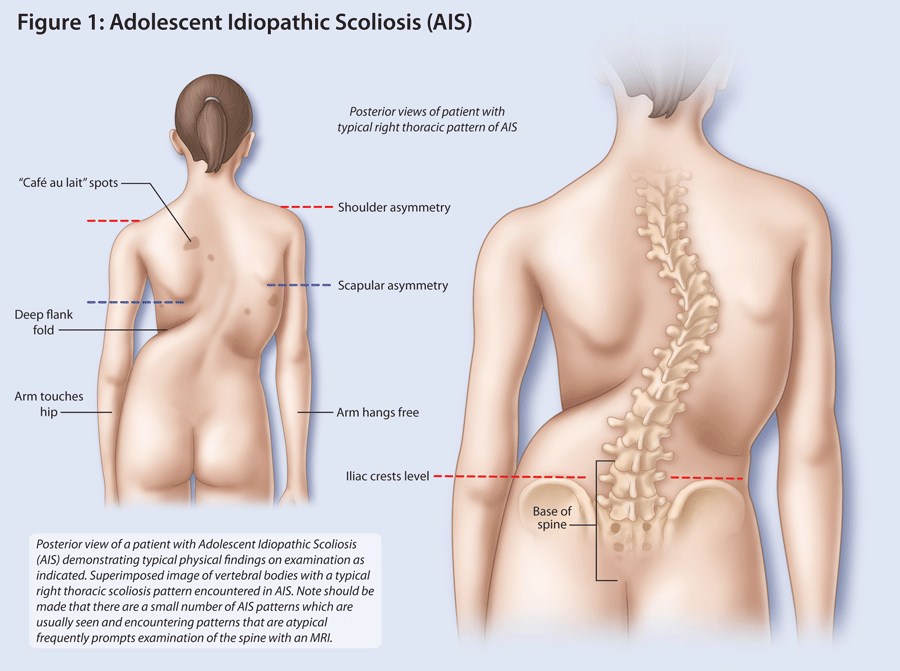
Abstract: Adolescent Idiopathic Scoliosis (AIS) is a condition requiring early detection for appropriate management. Bracing can be effective in preventing curve progression so failing to detect a small AIS curve in a growing child could result in losing the opportunity to avoid a major surgical procedure. Doubts about cost-effectiveness have ended most school screening programs and assessment is now provided mainly by primary care providers. The ability to conduct a quick effective scoliosis examination is important for the busy practitioner. This article illustrates the main features of the screening test, offers guides for imaging, and outlines appropriate tips for specialist referral.
Key Words: Adolescent Idiopathic Scoliosis (AIS), diagnosis, physical exam, Adams Forward Bend Test, primary care.

Members of the College of Family Physicians of Canada may claim MAINPRO-M2 Credits for this unaccredited educational program.

www.cfpc.ca/Mainpro_M2

You can take quizzes without subscribing; however, your results will not be stored. Subscribers will have access to their quiz results for future reference.

1. This can be done with a patient's gown open or closed at the back.
2. The measurement is performed with the examiner sitting and observing the patient from behind. It can be done at the same time as the AFBT, since the examiner is in the same position.
3. With the patient standing erect in bare feet and with the knees extended, the examiner rests his/her hands on top of the iliac crests with fingers extended and palms parallel to the floor. With both the patient's feet flat on the floor, the relative levels of the hands give a surprisingly sensitive estimate of significant LLD (Figure 2).
4. There are alternative methods to measure leg lengths with the patient supine by using a tape measure. These techniques require familiarity with pelvic and ankle landmarks, are time consuming and are remarkably prone to measurement errors.
IMAGING FOR SUSPECTED SPINAL DEFORMITY
1. Radiation exposure using modern radiographic techniques, including digital radiography, is significantly lower than in the past.5
2. Radiologists' reports may use terms related to the spine that can be misleading and worrisome. Cobb angles less than 10 degrees should not be described as scoliosis but rather as "spinal asymmetry" since the term "scoliosis" may prompt an unnecessary referral to a specialist.
3. If imaging is indicated, it is best done at a centre where the patient will be seen in consultation. Radiologists at these centres have the experience to accurately interpret imaging results and correctly report spinal deformity. This also avoids the unfortunate situation where inadequate imaging done elsewhere must be repeated at the referral centre, significantly increasing the patient's radiation dose.
4. Never order a "scoliosis series". It is an obsolete term that referred to pre-operative assessment films. It is still found on some x-ray requisition forms and may be ordered in a misguided attempt to provide the surgeon with as much information as possible. Since the vast majority of patients seen by the spine surgeon will not require surgery, this option is needlessly expensive and the added radiation may be harmful to the patient.
5. The authors allow patients to take smart phone or tablet images of their own spinal x-rays. This engages the patient and their parents or guardians in the management. Take account of all regulatory and privacy issues regarding patient's recording of even their own images.
To have access to full article that these tools were developed for, please subscribe. The cost to subscribe is $80 USD per year and you will gain full access to all the premium content on www.healthplexus.net, an educational portal, that hosts 1000s of clinical reviews, case studies, educational visual aids and more as well as within the mobile app.