
Pediatric diaper rashes: Getting to the 'bottom' of things
Members of the College of Family Physicians of Canada may claim one non-certified credit per hour for this non-certified educational program.
Mainpro+® Overview
Jacky Lo1, Joseph M. Lam, MD, FRCSC2
1Medical student, Department of Pediatrics, University of British Columbia, Vancouver, BC.
2Clinical Assistant Professor, Departments of Pediatrics and Dermatology, University of British Columbia, Vancouver, BC.
Abstract
Diaper dermatitis is one of the most common skin conditions seen in the pediatric population and can cause significant distress for infants and their families. While many diaper rashes can resolve with simple treatments, having a thorough understanding of different diaper lesions can help rule out more serious conditions, guide treatment and alleviate some of the caregivers' anxiety. The following review article will provide an overview of select common and uncommon diaper eruptions.
Key Words: diaper dermatitis, pediatric, diaper rash, treatment.
A diaper rash is one of the most frequent complaints presented in pediatric practice and has been reported by up to 75% of parents with infants.1 For the caregiver, the presentation of a diaper eruption can be a source of anxiety. For the physician, it can be a source of frustration as diagnosis can often be challenging given the clinical similarities that are shared among many cutaneous lesions. The purpose of this review article is to provide a brief overview and to assist practitioners with the identification, care and management of select common and uncommon diaper eruptions.
Common Diaper Eruptions
Irritant Diaper Dermatitis
Irritant diaper dermatitis (Figure 1) is one of the most widely seen causes of diaper eruptions in infants and can occur in up to 25% of diaper-wearing infants.2 It is an inflammatory reaction of the skin in the perianal area resulting from prolonged contact of urine and feces, moisture, alkaline pH and mechanical disruption. It often presents as an erythematous rash involving the buttocks, genitalia, lower abdomen and thighs and can be accompanied by maceration, erosion and when severe, ulceration. Typically, irritant diaper dermatitis spares the inguinal folds. Treatment of irritant diaper dermatitis aims to minimize the irritating effects of urine and feces, and may include frequent diaper changes, the use of a barrier cream and the use of superabsorbent diapers. For more severe cases, a short course of 1% hydrocortisone cream can also be considered.2

Candida Dermatitis
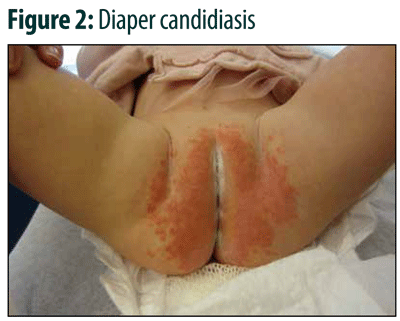
Diaper dermatitis secondary to Candida albicans (Figure 2) commonly affects young infants and is characterized by erythematous papulovesicular or pustular lesions.3 Some of the risk factors predisposing infants to candidiasis include young age, episodes of diarrhea and the use of broad-spectrum antibiotic and immunosuppressive therapies.2 Candida dermatitis is characterized by well-demarcated beefy red plaques and is often accompanied by satellite papules and pustules. It can involve the thighs, genital creases, abdomen and genitalia and is often seen with thrush. The diagnosis can be confirmed with a skin scraping examined under microscopy using potassium hydroxide and treatment is often with topical anti-fungal agents, such as nystatin, clotrimazole, ketoconazole and barrier creams such as zinc oxide.2,3
Allergic Contact Dermatitis
Allergic contact dermatitis (ACD) (Figure 3) was once thought to be a rare condition in children; however, in recent years, there is growing evidence in the literature that suggests that it is more common than previously believed.4 ACD typically appears in areas exposed to the allergen and presents as an erythematous, intensely pruritic eczematous lesion sparing the inguinal folds. In severe cases, the lesions may become edematous and vesiculobullous.2 ACD may develop from exposure to the diaper or to products applied to the area. Common allergens documented in the literature include sorbitan sesquioleate, an emulsifier