Members of the College of Family Physicians of Canada may claim one non-certified credit per hour for this non-certified educational program.
Mainpro+® Overview
Dr. Julia Alleyne, BHSc(PT), MD, CCFP, Dip. Sport Med MScCH, is a Family Physician practising Sport and Exercise Medicine at the Toronto Rehabilitation
Institute, University Health Network. She is appointed at the University of Toronto, Department of Family and Community Medicine as an Associate Clinical Professor.
Yoga Raja Rampersaud, MD, FRCSC, Associate Professor Department of Surgery, University of Toronto, Divisions of Orthopaedic and Neurosurgery, University Health
Network Medical Director, Back and Neck Specialty Program, Altum Health, Past President Canadian Spine Society, Toronto, ON.
Jess Rogers is the Director at the Centre for Effective Practice (CEP). Jess' role includes developing evidence-based clinical guidance for providers. Jess was
the Project Lead in executing the primary care provider education component of Ontario's Low Back Pain initiative including the CORE Back Tool. CEP is pleased to have funded the
update of the CORE Back Tool 2016 to continue supporting primary care providers.
Dr. Hamilton Hall, MD, FRCSC, is a Professor in the Department of Surgery at the University of Toronto. He is the Medical Director, CBI Health Group and Executive
Director of the Canadian Spine Society in Toronto, Ontario.

Abstract
Through the redesign of the already successful Clinically Organized Relevant Exam (CORE) Back Tool, primary care clinicians now have a more comprehensive,
user-friendly approach to clinical decision making for patients presenting with low back pain. The key components of the tool include a high yield history connected to mechanical
low back pain patterns, embedded key patient messages, clear listing of appropriate radiological indications, criteria for consultant referrals as well as a management matrix
geared to office practice. A clinical case will be used to demonstrate the application of the tool to practice and instruct the reader on the key features.
Key Words: Low Back Pain, Tool, Primary Care Providers, Management.
In March 2013, Ontario launched the CORE Back Tool1 as a key component of its Low Back Pain Strategy. This tool was designed for primary care providers by primary
care providers through focus groups that identified the common gaps in practice leading to unnecessary investigations and consultations. Knowledge experts were engaged to
formulate an evidence-based approach to low back pain, which supports clinical decision making and enhances health care provider knowledge and attitudes. The Centre for Effective
Practice managed the tool development from design to delivery and oversaw an online course completed by over 5000 health care providers. Across the country, clinicians stated that
the CORE Back Tool was having an important impact on the assessment and management of patients with low back pain in their practices.
Evaluation is an important component of the project and an analysis of usability for clinical practice and focus group feedback confirmed that the tool had hit a needed target but
health care providers wanted more clarity of terms, greater connections between key concepts and clear management options. In 2016, Centre for Effective Practice supported and
managed a redesign of the CORE Back Tool with embedded referencing, enhanced pattern recognition and the addition of a management matrix.2
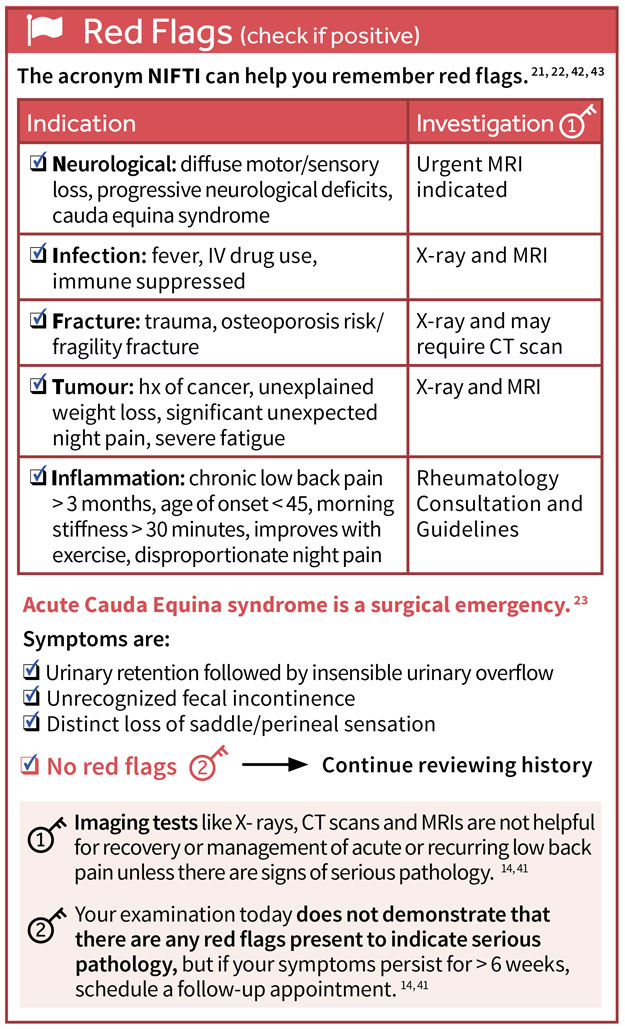
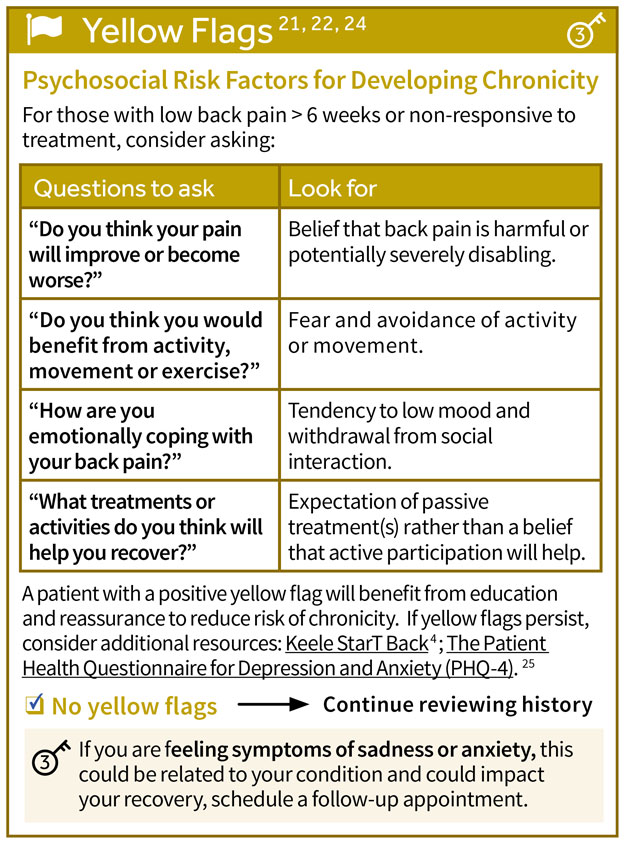
Reference numbers in the illustrations are from the CORE. References in the text appear at the end of this article. The Tool can be downloaded by clicking the button below.
New and Improved CORE Low Back Tool
- Evidence-informed approach with inserted references
- Low back pain pattern recognition within history questions
- Appropriate radiological investigations linked to red flags
- Easy-to-ask Yellow Flag questions
- Patient Key Messages embedded into clinical assessment
- One page education summary for primary care providers
- Easy to follow management matrix for office based care.