Advertisement

Advertisement

health equity

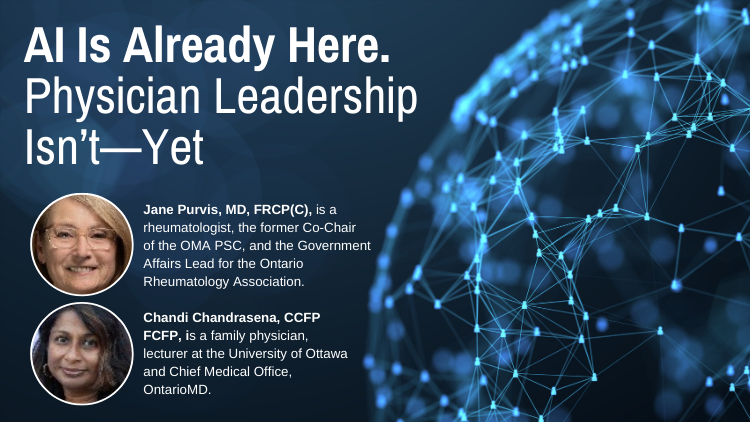
AI Is Already Here. Physician Leadership Isn’t—Yet

Teaser: 

1Dr. Jane Purvis, MD, FRCP(C), 2Dr. Chandi Chandrasena, CCFP FCFP,

1is a rheumatologist, the former Co-Chair of the OMA PSC, and the Government Affairs Lead for the Ontario Rheumatology Association. 2is a family physician, lecturer at the University of Ottawa and Chief Medical Office, OntarioMD.

CLINICAL TOOLS

Abstract: AI is rapidly integrating into Ontario’s healthcare system, offering benefits like reduced administrative burden and improved clinical decision-making, but carrying significant risks including patient safety concerns, equity gaps, and erosion of primary care. Effective, physician-led governance is essential to ensure AI complements rather than replaces human-centred care.
Key Words: Artificial intelligence, physician governance, primary care, health equity.
1. AI tools are already embedded in Ontario’s clinical environments, often adopted without independent evaluation or robust local validation.
2. While AI scribes and clinical decision-support systems offer real efficiency gains, risks include hallucinations, diagnostic errors, and erosion of the therapeutic relationship.
3. Poorly governed AI threatens to fragment longitudinal primary care, which depends on continuity, trust, and contextual knowledge that algorithms cannot replicate.
4. Equitable AI implementation requires inclusive training data, privacy safeguards, and deliberate policy oversight—market forces alone are insufficient.
AI supplements, never substitutes: AI chatbots process snapshots of information and lack relational memory or accountability — patients who arrive with AI-formed diagnoses may need careful, time-conscious counselling to realign expectations.
Document AI-influenced encounters carefully: AI scribes can introduce inaccuracies into the medical record; physicians retain medicolegal responsibility and should review all AI-generated documentation before signing.
To have access to full article that these tools were developed for, please subscribe. The cost to subscribe is $80 USD per year and you will gain full access to all the premium content on www.healthplexus.net, an educational portal, that hosts 1000s of clinical reviews, case studies, educational visual aids and more as well as within the mobile app.
Disclaimer: 
Disclaimer at the end of each page

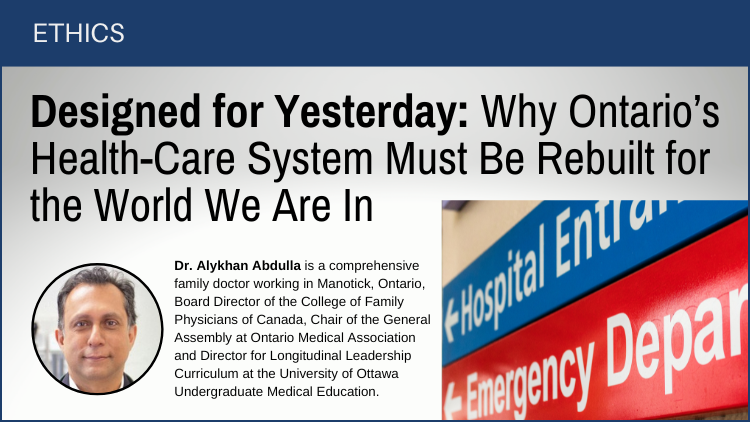
Designed for Yesterday: Why Ontario’s Health-Care System Must Be Rebuilt for the World We Are In

Teaser: 

Dr. Alykhan Abdulla, BSC, MD, LMCC, CCFP, DipSportMed CASEM, FCFP, CTH (ISTM), CCPE, Masters Cert Phys Leader, ICD.D

is a comprehensive family doctor working in Manotick, Ontario, Board Director of the College of Family Physicians of Canada, Chair of the General Assembly at Ontario Medical Association and Director for Longitudinal Leadership Curriculum at the University of Ottawa Undergraduate Medical Education. Editor in Chief/Author Journal of Current Clinical Care SPORTS MEDICINE, Past Chair Section of General and Family Practice Ontario Medical Association, Bruyere Foundation

CLINICAL TOOLS

Abstract: Ontario’s health-care system is not in crisis—it is in structural failure, the predictable result of design choices made for a different era. Decades of efficiency-first planning, chronic underinvestment in the workforce, hospital over-reliance, fragmented services, and political short-termism have left the system brittle and unable to absorb modern pressures. Rebuilding requires not more temporary fixes, but honest reckoning and a fundamental commitment to upstream, team-based, digitally connected, community-centred care.
Key Words: Health system reform, primary care, workforce sustainability, health equity.
1. Ontario’s health-care system is in structural failure, not episodic crisis—the result of decades of design choices built for stable conditions that no longer exist.
2. Efficiency-first planning has produced a brittle system without surge capacity, workforce buffers, or meaningful community-based alternatives to hospital care.
3. Workforce sustainability requires long-term commitment to retention, competitive compensation, and faster integration of internationally trained professionals—not periodic recruitment campaigns.
4. Rebuilding the system demands upstream investment, care integration, digital connectivity, and AI-enabled community-based infrastructure—not more acute-care expansion.
Document the system, not just the patient: When patients cannot access specialist care, home support, or mental health services in a reasonable timeframe, document those gaps explicitly in the chart. Systemic failures become visible—and actionable—only when they are recorded.
Advocate upstream: Family physicians sit at the point where system failures become individual suffering. That position carries professional responsibility. Engaging with your professional association, participating in policy consultations, and lending your voice to reform efforts is not optional activism—it is part of the role.
To have access to full article that these tools were developed for, please subscribe. The cost to subscribe is $80 USD per year and you will gain full access to all the premium content on www.healthplexus.net, an educational portal, that hosts 1000s of clinical reviews, case studies, educational visual aids and more as well as within the mobile app.
Disclaimer: 
Disclaimer at the end of each page