Advertisement

Advertisement

Treatment Strategies for Pressure Ulcers

Madhuri Reddy, MD, Dermatology Day Care (Wound Healing Clinic), Sunnybrook and Women's College Health Care Centre, Toronto, ON, Associate Editor, Geriatrics & Aging.

R. Gary Sibbald, BSc, MD, FRCPC (Med), FRCPC (Derm), MACP, DABD, Associate Professor and Director of Continuing Education, Department of Medicine, University of Toronto, Toronto, ON.

Introduction
Pressure ulcers are areas of localized damage to the skin and underlying tissue caused by pressure, shear, friction, excess moisture, incontinence or abrasion. They usually occur over bony prominences such as the sacrum, heels, hips and elbows (Figure 1).
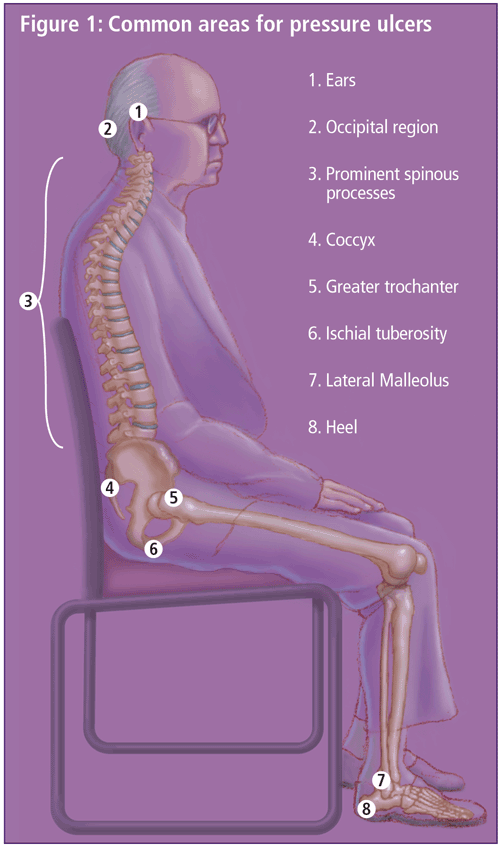
Pressure ulcers are associated with a significant burden of illness in the elderly and a significant financial burden to the health care system. In a recent study of a geriatric unit in Glasgow, the prevalence of pressure ulcers was 41%.1 The incidence in acute care2 has been estimated at 10%, and up to 60% of patients develop ulcers while in acute care hospitals.3 In one study, the prevalence of stage I-IV pressure ulcers in 1,960 acute care facilities in Canada from 1995-1998 was 11.2%.4 The incidence rate for home care is 15.4%.5 Approximately 45% of all pressure ulcers are probably preventable.

Annually, 1.7 million patients in the U.S. develop pressure ulcers, and the resultant costs to the health care system exceed $8.5 billion US/year.3 Databases describing almost 20, 000 long-term care (LTC) residents show an increased risk of death from ulcer complications, even controlling for other conditions.7 Several studies have shown that prevention programs in LTC are cost effective1 and may reduce the burden of pain and significantly improve patient quality of life.

Collecting data on pressure ulcers in and of itself helps to increase health care provider awareness and reduce the prevalence of pressure ulcers in LTC facilities. In The Netherlands, where prevalence studies on pressure ulcers had been conducted previously, eighty-nine health care facilities were surveyed. Almost all facilities were persuaded that their prevalence rate had to be changed and were planning activities to change pressure ulcer management. Fifty percent had already implemented some actions.7

The objectives of this article are: to identify the impact of pressure ulcers (mortality, morbidity and cost); to outline the risk factors for developing pressure ulcers; to develop an approach to pressure ulcer treatment; and to aid health care professionals in selecting appropriate surfaces and prevention based on the best evidence.

Pathophysiology
When pressure applied to a body surface exceeds pressures within the capillary (Capillary Closing Pressure, CCP), blood flow is reduced. The average value for the CCP is 32 mmHg in the fingertips of healthy males, but ranges from 20-40 mmHg. Prolonged decrease in blood flow can result in microvascular vessel occlusion and hypoxia, which leads to localized tissue ischemia, causing inflammation, increased vascular permeability and protein accumulation in the local interstitium. The result is increased tissue edema and the worsening of perfusion. Staging of pressure ulcers is outlined in Figure 2.

Maintenance of interface pressures below capillary closing pressure is often cited as the gold standard in pressure reduction/relief.8 Pressure Reduction is defined as reduction of interface pressure, but not necessarily below CCP. Pressure Relief is defined as reduction of interface pressure below CCP.

Risk Assessment Tools
Of those patients admitted to nursing homes (NH) who developed pressure ulcers, 80% developed within two weeks of admission, and 96% within three weeks of admission.9 Fortunately, risk assessment in institutions can decrease the incidence of pressure ulcers by about 60% and reduce the cost of prevention.9

There are two risk rating scales recommended by the
