 Reviewed By: Barry Goldlist, MD, FRCPC, FACP
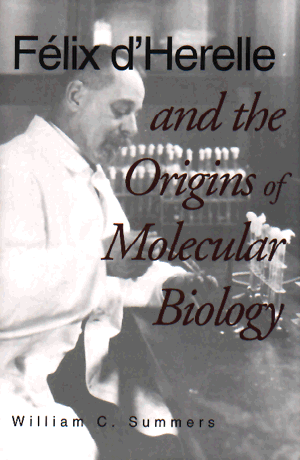
FÉLIX D'HERELLE AND THE ORIGINS OF MOLECULAR BIOLOGY
William C Summers
Yale University Press
New Haven and London
1999
ISBN 0300071272
This textbook is a combination book, partly the biography of an exceptional individual and partly a history of scientific discovery. The author, William Summers, is eminently qualified to write such a text, being a physician, scientist, and historian at Yale University.
D'Herelle is a renowned Canadian Scientist about whom I was totally ignorant. Born in Montreal, he traveled and lived in numerous areas around the world, although France became his eventual home. He never gave up his Canadian citizenship, however. D'Herelle was born to a wealthy family in Montreal, and after high school he traveled extensively, thanks to a gift from his mother. He never found time to return to formal schooling, but he learned enormous amounts in his chosen field, microbiology. His seminal scientific discovery was the description of bacteriophages, and their possible application in human infectious diseases. For this he received numerous awards, and at one time was a research professor at Yale University despite his own lack of formal education. Dr. Summers clearly delineates the process of scientific discovery, and the subsequent controversies over the nature of this new discovery (was it really a living organism or an enzyme?), and the determination of scientific priority. There is a fair amount of technical description, but Dr. Summers is a clear and logical writer who is able to guide the reader through the scientific process.
This book is an incredible work of scholarship, with extensive use of primary source documents. However, because the main thrust of this book is one of scientific discovery, we get very little analysis of d'Herelle's personality. I would have been interested in some speculation on how his lack of formal education might have influenced his often-stormy relationships with other scientists. Also, why was such a distinguished scientist so poorly treated at the Pasteur Institute, his spiritual home? There would be much to learn from a biography of this highly complex individual. Meanwhile, this is an excellent book that helps us understand the nature of scientific enquiry while saluting an outstanding scientist, who just happens to be Canadian.