
Appropriate Management of Temporomandibular Disorders in the Elderly
Benjamin R. Davis, BSc, DDS, FRCD(C), Department of Oral and Maxillofacial Surgery, Queen Elizabeth II Health Sciences Centre, Halifax, NS.
Temporomandibular disorders (TMDs) are common and can be divided into either muscular or intra-joint conditions. With advancing age, the craniomandibular complex undergoes changes that are similar to other musculoskeletal structures. Many of these changes may explain the decrease in incidence of TMDs seen in the older population. Conservative treatment is usually effective at decreasing TMD pain and improving function. A small percentage of patients will benefit from surgery when appropriate conservative measures have failed, and an intra-joint etiology has been definitively established.
Key words: temporomandibular disorders, aging, facial pain, temporomandibular joint surgery.
Introduction
The ability to comfortably chew, swallow, speak and perform facial movements is dependent upon an asymptomatic craniomandibular complex. The normal function of this intricate complex is dependent upon the precise interplay between the paired muscles of mastication, the bilateral temporomandibular joints (TMJs) and the dental occlusion. The most frequently used term to collectively define the clinical problems involving these structures is temporomandibular disorder (TMD).1 The American Academy of Orofacial Pain has defined TMD as being characterized by pain in the muscles of mastication, the preauricular region and/or TMJ that is usually aggravated by function or manipulation.2 A limited range of mandibular motion or asymmetric motion is frequently seen, as are joint sounds or "jaw locking".
Inadequate training of health care providers in TMD management is widespread. Furthermore, appropriate management depends upon correct diagnosis which can be difficult due to frequently complex and confusing patient symptomatology. Thankfully, the majority of TMDs are self limiting and easily managed by conservative means. However, surgery does have a small but important role, as approximately 5% of patients presenting with TMD will not have resolution of their symptoms with conservative means alone. This paper will discuss the appropriate management of those conditions affecting the temporomandibular joint in the older patient.
Classification of Temporomandibular Disorders
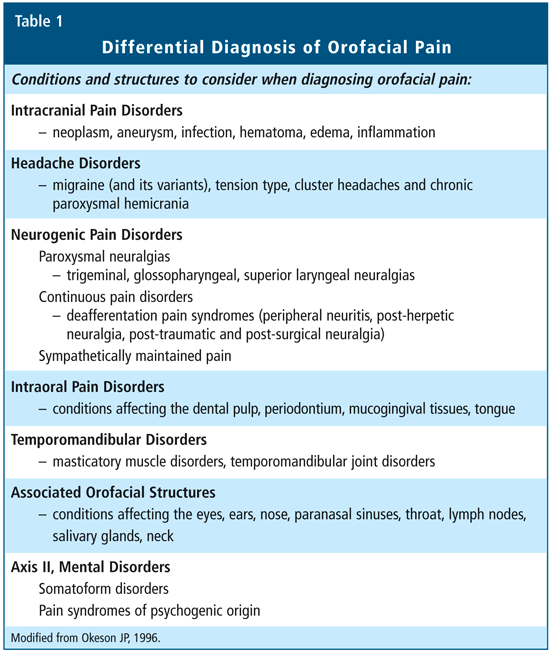
Numerous classification systems have been devised to categorize the diverse causes of facial pain. The constellation of TMDs is one of the most frequent causes of facial pain, but many non- TMD-related reasons for facial pain exist (Table 1). Most often, TMDs are separated into joint disorders and masticatory muscle disorders (Table 2). In our tertiary care facility, most patients present with a combination of both joint and masticatory muscle pain. However, masticatory muscle disorders are more prevalent in the general population.
No difference in pain severity or duration appears to exist between pure masticatory muscle pain and intra-joint pain. However, patients suffering from masticatory muscle pain seem to demonstrate more dysfunctional behavioural profiles and suffer significantly higher psychological distress then those suffering intra-joint pain.3
Age-related Changes in the Craniomandibular Complex
Numerous changes occur in the craniomandibular complex with increasing age, most of which mimic changes seen elsewhere in the body. A significant reduction in the cross-sectional area and densities of both the masseter and medial pterygoid muscles has been noted with advancing age.4 This explains why masticatory muscle performance is lower in older patients and may also account for Bader, et al.'s observation that the incidence of sleep bruxism, considered a precipitating factor for TMD, decreases among older patients.5
Age-related changes also have been noted in the TMJ disc (meniscus) and retrodiscal tissue. An examination of 106 cadaveric human TMJ discs demonstrated some degree of either thinning or perforation in 38% of individuals aged 65-85 years.6 A decrease in vascularity and number of fibroblasts and an increase in dense connective tissue also have been observed in