Advertisement

Advertisement

Current Clinical Care

A Case of Large Nasal Vestibular Mass presenting with Nasal Obstruction and Epistaxis

A Case of Large Nasal Vestibular Mass presenting with Nasal Obstruction and Epistaxis

Members of the College of Family Physicians of Canada may claim one non-certified credit per hour for this non-certified educational program.

Mainpro+® Overview
Teaser: 

P.K. Shenoy, MD, FRCS, DLO, FACS, ENT Service Chief, Campbellton Regional Hospital, Campbellton, NB, Canada.

Dr. Lyew Warren, MD, FRCSC, Consultant Pathologist, Campbellton Regional Hospital, Campbellton, New Brunswick, Canada.

Abstract
Nasal vestibular mass are not commonly seen in ENT practice. We are presenting a patient with a large right nasal vestibular mass, who complained of nasal obstruction and epistaxis. Differential diagnosis of the similar growths in the nasal vestibule with their pathology and the treatment options, have been reviewed from the literature.
Key Words: Nasal vestibular mass, papilloma, 0 and 30 degree endoscopes, lateral rhinotomy.


The Cost of Dementia in the United States

The Cost of Dementia in the United States

Teaser: 

Dr.Michael Gordon Michael Gordon, MD, MSc, FRCPC, Medical Program Director, Palliative Care, Baycrest Geriatric Health Care System, Professor of Medicine, University of Toronto, Toronto, ON.
The prevalence of dementia appears to be increasing in most western countries. That when coupled with the increased average age of the older population has leads to an expectation that projections of financial costs to individuals, families and to society will grow over the next few decades. The current study, out of the United States, based on a number of robust data bases coupled with in-depth interviews has resulted in projections of the current true costs of caring for elderly people living with dementia. It also allowed for the projection of future costs over the next three decades. The results are quite mind-boggling: "We found that dementia leads to total annual societal costs of $41,000 to $56,000 per case, with a total cost of $159 billion to $215 billion nationwide in 2010. Our calculations suggest that the aging of the U.S. population will result in an increase of nearly 80% in total societal costs per adult by 2040."

About Acne

About Acne

WHAT IS ACNE?

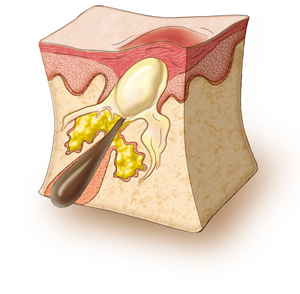
Human skin is covered in hundreds of thousands of microscopic hair follicles, called pores. These are particularly prominent on the face, neck, back, and chest. These pores are connected to oil glands under the skin that make a substance called sebum. Sometimes these follicles produce too many cells and become blocked. As a result, sebum (oil) gets trapped and bacteria (P. acnes) begin to grow.1,2,4

Acne is the most common skin condition.1,4

Quick Facts/Frequently Asked Questions

Quick Facts/Frequently Asked Questions

WHAT IS ACNE?

  • Human skin is covered in hundreds of thousands of microscopic hair follicles, called pores. These are particularly prominent on the face, neck, back, and chest. These pores are connected to oil glands under the skin that make a substance called sebum. Sometimes these follicles produce too many cells and become blocked. As a result, sebum (oil) gets trapped and bacteria (P. acnes) begin to grow.1,2,4

Treatment Options

Treatment Options

MEDICATIONS FOR ACNE

  • Treatment for acne has several goals: to heal pimples, to prevent pimples (by decreasing sebum production, killing bacteria, and normalizing skin shedding), and to prevent scarring.1,6

  • Over-the-counter (OTC) or prescription drugs may be used.

Living with Acne

Living with Acne

CARING FOR YOUR SKIN

  • Cleanse your skin gently. Do not scrub – this can aggravate acne.1
  • Wash your skin twice a day with a mild cleanser and water. More frequent washing will not improve your acne, and it might irritate your skin and make the acne worse.2
  • Don’t squeeze or pick at your pimples. Squeezing forces infected material deeper into the skin, making the inflammation worse and possibly leading to scarring.1,2
  • Shave carefully and lightly.1

Colite ulcéreuse : Éducation des patients : Vivre avec la CU

Teaser: 

Are the symptoms permanent?
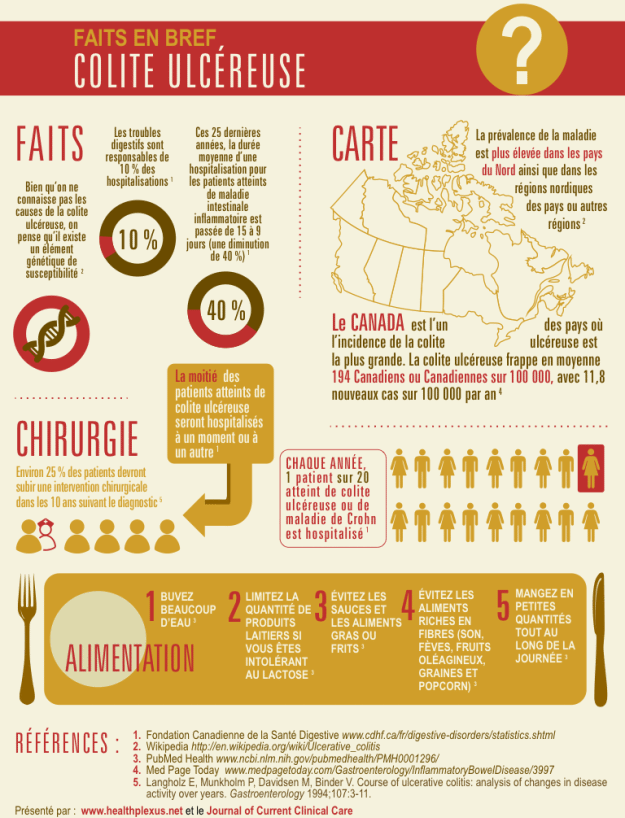
Although there are effective and safe medications for treating ulcerative colitis (UC), this disease cannot be cured. This means that your best chance of staying in remission is to continue on your prescribed medical therapy, even when you are feeling well.

Coping with UC?
...

Ulcerative Colitis: Patient Education: FAQs about UC

Teaser: 

Are the symptoms permanent?
Although there are effective and safe medications for treating ulcerative colitis (UC), this disease cannot be cured. This means that your best chance of staying in remission is to continue on your prescribed medical therapy, even when you are feeling well.

Coping with UC?
...